
Every day, Google processes millions of copyright removal requests from creators around the world. What most people don't know is that Google publishes all of this data publicly, in real time, in something called the Google Transparency Report.
This report is more than a statistic. For content creators, it's a verifiable, third-party ledger of the entire DMCA ecosystem. It shows who is filing takedowns, how many, and, critically, on behalf of how many unique copyright owners.
That last metric is where Rulta stands alone.
| Stat | Figure |
|---|---|
| Total URLs removed | 17B+ |
| Unique copyright owners | 886K+ registered in Google's database |
| Rulta's rank | #1 most unique copyright owners of any service |
What Is the Google Transparency Report?
The Google Transparency Report (Copyright section) is a public, real-time database that Google maintains to document every DMCA takedown request it receives for its Search index. It has been published continuously since 2012 and updates daily.
The report is organized around three types of actors:
Copyright Owner. The individual or entity whose content was stolen. In most cases for Rulta's users, this is the creator themselves, a photographer, model, or digital artist.
Reporting Organization. The service or company filing the takedown on the owner's behalf. This is where Rulta appears in the report.
Targeted Domain. The website hosting the infringing content. Google tracks how many unique domains each organization has successfully targeted.
Key distinction: The report tracks requests submitted, not content deleted from the web. A successful Google DMCA notice removes a URL from Google Search results. It does not delete the file from the hosting server. This is why comprehensive protection requires takedowns directly to hosting providers in addition to Google Search.
How to Read the Report
The Transparency Report's data explorer lets you search by reporting organization, copyright owner, or targeted domain. Here's the fastest way to make sense of it.
Step 1. Go to transparencyreport.google.com/copyright/overview
Step 2. Click "Explore the data" and select "Reporting organizations"
Step 3. Search for the name of any DMCA service, including Rulta, to see their total request volume and unique copyright owner count
Step 4. Cross-reference the "Copyright owners" tab to verify individual creator records
Step 5. Note the difference between raw request volume and unique owner count. Volume can be inflated by automation. Owner count reflects actual user base size.
Why Unique Copyright Owners Is the Metric That Matters
Raw takedown volume is an easy number to game. A single organization could submit millions of requests for a handful of clients, inflating its apparent activity. Volume tells you about operational scale. It does not tell you about accuracy or creator trust.
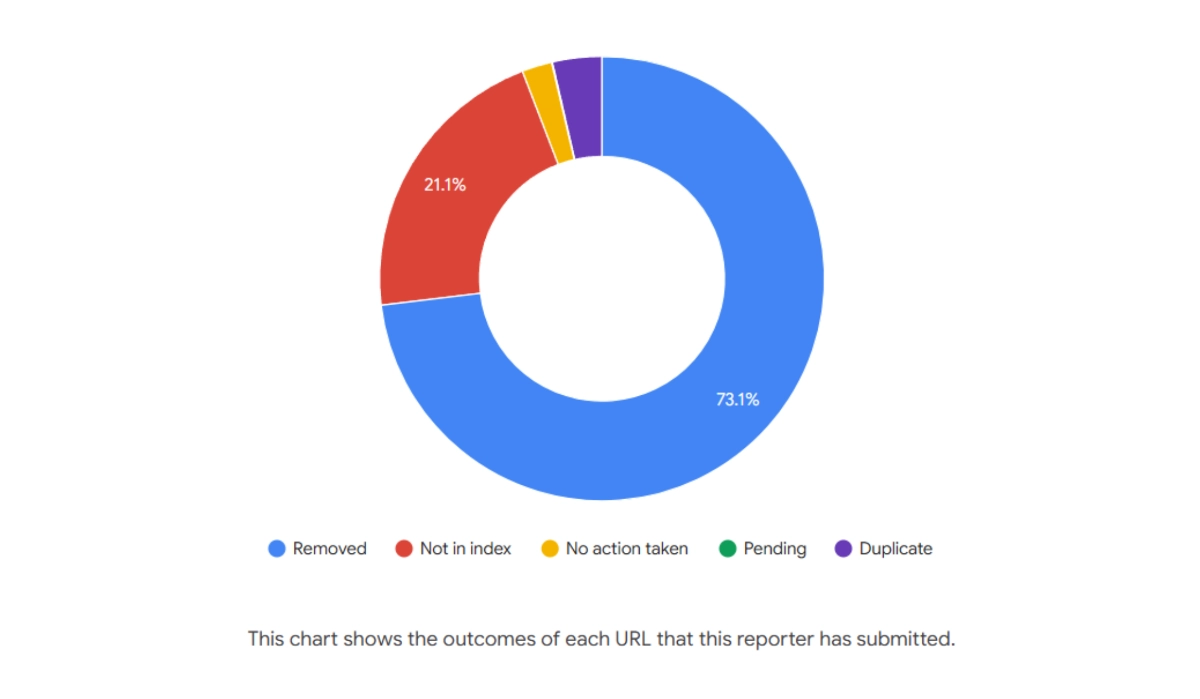
This chart shows the outcomes of each URL that Rulta has submitted:
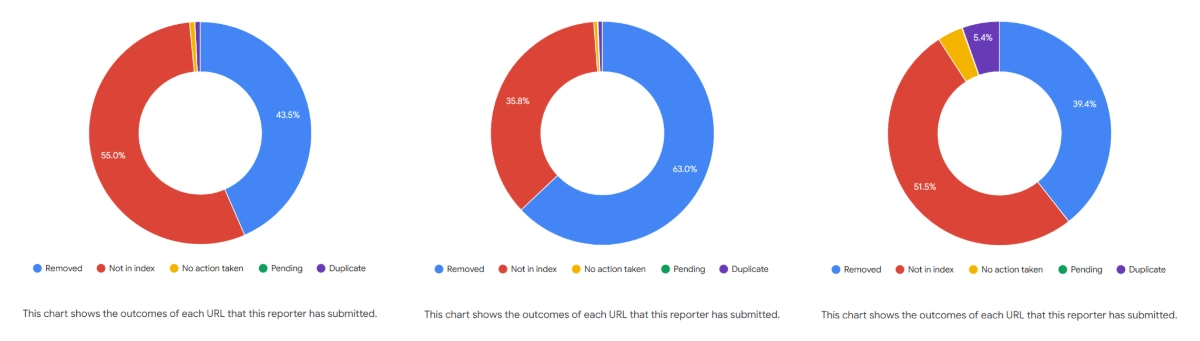
These charts show the outcomes of each URL that other DMCA companies have submitted:
Unlike volume (URLs requested to be delisted) the number of unique copyright owners is harder to manipulate. It counts the number of distinct people or entities whose content a service has filed on behalf of. It is, in effect, a proxy for user base size, and it's measured by Google, not by the service itself.
Among all reporting organizations in Google's Transparency Report, Rulta represents the highest number of unique copyright owners. This means more individual creators have trusted Rulta to protect their work on Google Search than any other DMCA service in the database.
For content creators evaluating DMCA services, this is the most meaningful third-party signal available. It isn't a testimonial, a rating, or a marketing claim. It is a data point published and maintained by Google itself.
What the Report Does Not Tell You
The Google Transparency Report is powerful, but understanding its limits matters as much as reading its numbers.
It only covers Google Search. The report does not include takedowns filed directly to hosting providers, social platforms, Bing, or adult content indexers. Google Search is one channel in a multi-platform protection strategy, and for many creators, not the most critical one.
Removal from Google is not removal from the internet. A successful takedown removes the infringing URL from Google's search index. The content remains live on its host server and is still accessible via direct link. A full protection service like Rulta pursues hosting-level takedowns in addition to search deindexing.
Volume does not equal accuracy. Services with high request volumes but low approval rates waste creators' time and risk counter-notices.
Why Rulta Is #1 in the Report
Rulta has been protecting content creators since 2015. The volume of unique copyright owners Rulta represents in Google's Transparency Report is a direct reflection of that decade-long focus on creator protection. Not enterprise clients, not music labels, not film studios. Individual creators.
That specialization shows up in the data because creators keep using the service, and because Rulta keeps filing on their behalf. The Transparency Report's copyright owner count grows when a new creator joins and their first takedown is submitted. It is, in the most literal sense, a count of how many creators have chosen Rulta.
More content creators have registered their copyright with Rulta than with any other DMCA service tracked by Google. This makes Rulta, by Google's own data, the world's most-used DMCA service among content creators.
If you create content online, on OnlyFans, YouTube, Instagram, or anywhere else, your work is being indexed, copied, and uploaded without your permission every day. The Google Transparency Report shows, without ambiguity, which service the largest number of creators in your position have already chosen to fix that problem.
Start Protecting Your Content
Join the creators who are already protecting their work.
Sources: Google Transparency Report (transparencyreport.google.com/copyright/overview), Gigazine / TorrentFreak analysis of 2024 DMCA volume data. Unique copyright owner count as recorded in Google's live database. Statistics subject to change as Google updates its report daily.
